SPC sounds great in theory – catch problems early, reduce waste, keep customers happy. But the reality? A lot of companies implement SPC and somehow still end up worse off. Not because SPC doesn't work, but because they're doing it wrong in ways that actively cost them money.
We've seen businesses spend thousands on SPC software and training, only to have it collect dust because nobody's actually using it properly. Or worse – they use it, but they're measuring the wrong things, or they're reacting to false alarms, or they're ignoring the real signals.
Let's talk about the mistakes that bleed money from your operation, and how to dodge them.
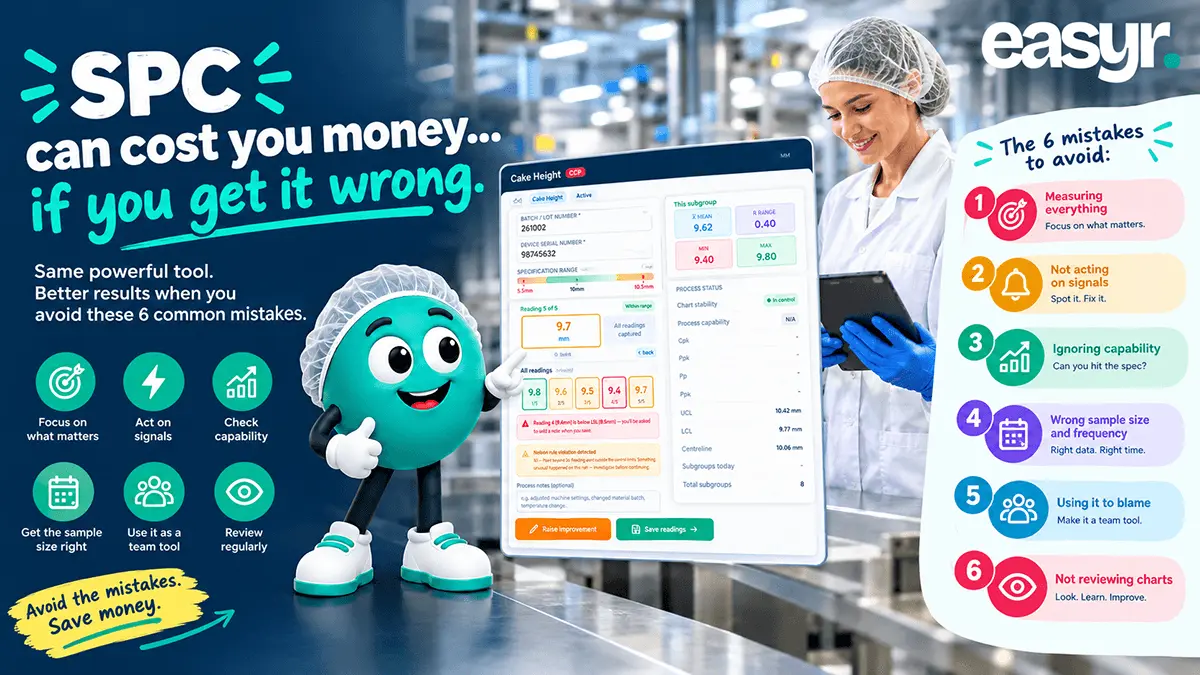
- Measuring everything instead of what matters
- Seeing a signal and not acting on it
- Ignoring whether your process can actually hit the spec
- Getting sample size and frequency wrong
- Using SPC to blame people
- Never reviewing your charts
Mistake 1: Measuring Everything
 This one's deceptively common. A company gets excited about SPC and decides "let's track everything." They start monitoring 47 different measurements across every process step.
Here's what happens: you get data overload. Your operators are drowning in charts. The signal gets lost in the noise. And you're paying for all that monitoring – equipment, labour to collect data, time to analyse it – on things that don't actually matter.
The truth is, you only need to monitor the things that affect your quality, safety, or cost. Pick the critical characteristics. For a food manufacturer, that might be temperature, pH, and weight. For a widget maker, it might be dimensions and hardness. Quality of life improves when you focus on what counts.
Mistake 2: Not Acting on What You See
 You've got beautiful control charts. Your process signals that something's changed. And then... nothing happens. The operator sees the signal and keeps running. The supervisor doesn't check it out. By the time someone reacts, you've made 500 bad parts.
This happens because nobody's trained on what to do when SPC says "something's wrong." Or because the culture doesn't support stopping the line to investigate. Or because management hasn't clearly defined: "this control chart signal means you stop and investigate, full stop."
An SPC system with nobody acting on it is just an expensive chart generator. The money comes from action, from catching and fixing problems before they become expensive.
Mistake 3: Ignoring Your Process Capability
Some companies implement SPC without ever checking if their process is actually capable of meeting specifications. They'll be running along, everything looks controlled, and then the data gets analysed and surprise – they're making 30% scrap because their process can't hit the spec.
You need to know your Cpk early. If your process isn't capable, SPC alone won't fix it. You might need better equipment, tighter procedures, different materials, or a fundamental redesign. But you need to know that before you invest in fancy monitoring.
Mistake 4: Wrong Sample Size and Frequency
Getting the sample plan wrong costs you either way:
- Too few samples and you miss problems.
- Too many samples and you're wasting time and money collecting data you don't need.
- Too infrequent? You're flying blind between checks.
- Too frequent? You're reacting to normal variation like it's a problem.
Getting the sampling plan right is crucial. It needs to match your risk, your process speed, and your process stability. A slow, stable process might only need sampling every hour. A fast, variable process might need continuous monitoring. This isn't one-size-fits-all.
Mistake 5: Using SPC as a Blame Tool
This is the cultural mistake that kills adoption. SPC is introduced, and suddenly it becomes a way to prove an operator made a mistake. "Look, your shift is the one that went out of control."
When SPC becomes a blame tool, operators stop reporting problems. They ignore signals. They game the system. Your error detection disappears and your improvement stops cold.
SPC should be a team tool:
“Look, here's what the process told us, let's figure it out together.”
When it's framed that way, everybody's motivated to use it properly.
Mistake 6: Not Reviewing Your Charts
This is surprisingly common. Companies set up monitoring and then nobody actually looks at the results. Not regularly, not systematically. The data's being collected, but it's not being analysed.
You need regular review – daily for critical processes, weekly for standard ones. Someone needs to look at trends, spot patterns, notice when things are slowly drifting out of spec. That review is where the intelligence comes from.
The Cost of Getting It Right
 When you avoid these mistakes, the payoff is real:
- Better first-pass yield
- Fewer customer complaints
- Faster problem-solving
- Less waste material
- Happier operators who actually understand what's going on
The money you save comes from prevention, not detection. From fixing problems before they become expensive. From understanding your process so well that you can make smart decisions, not guess.

Make SPC something your team actually uses
Easyr is built for operators, not statisticians - quick to enter a reading, clear about what to do next. Have a chat with us and we'll show you how it works.
Get in touch