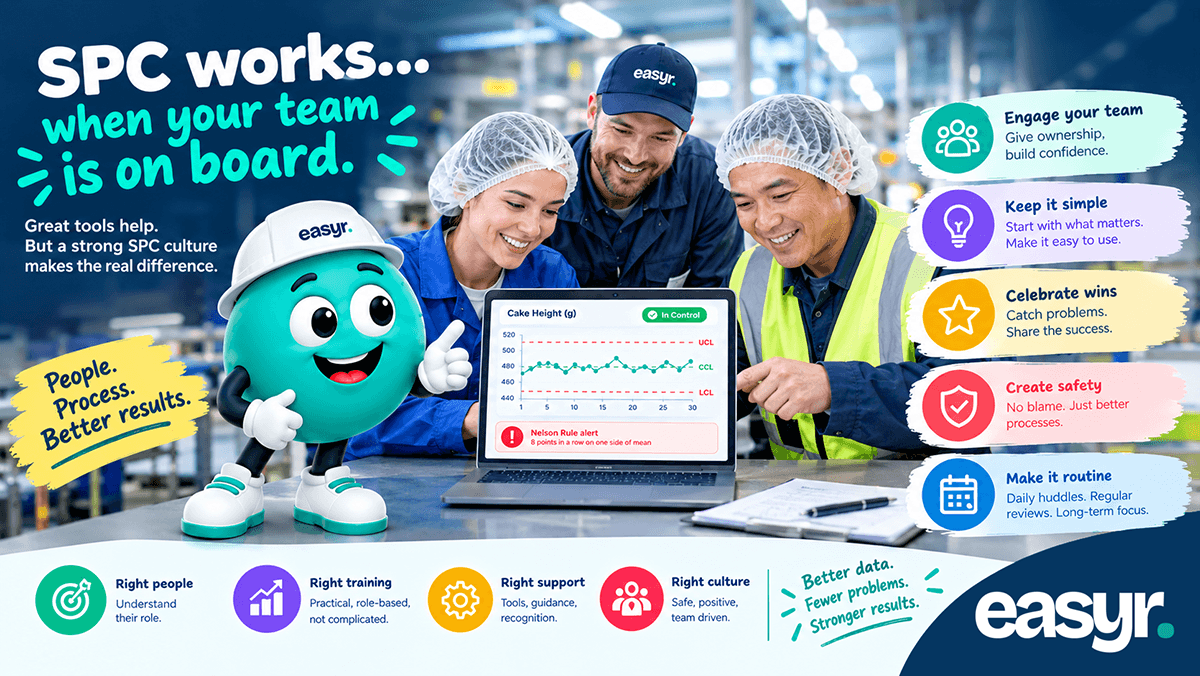
SPC only works if your team buys in. You can have the best system in the world, but if your operators are just ignoring the charts and your supervisors aren't backing up the process, you've wasted your money.
Building a real SPC culture means getting people excited about understanding their process. It means creating an environment where people want to catch problems, where they feel safe raising signals, and where they see the connection between good SPC and good results.
Here's how to build that culture from the ground up.
- Start with why SPC matters to each person, and keep the first chart really simple.
- Give operators ownership, celebrate catches, and make it safe to raise a signal.
- Make chart review part of the daily rhythm, and keep it going over time.
Start with Why, Not How
 Before you teach anyone about control charts or statistics, help them understand why SPC matters to them personally. Not in a corporate vision statement way – in a real, "this is what's in it for you" way.
- For operators: "This system will make your job easier. Instead of guessing whether something's wrong, the system tells you. You'll spend less time troubleshooting and more time doing good work. And when something does go wrong, you'll catch it before it becomes a mess."
- For supervisors: "You'll know what's really happening in your area. You'll spot trends before they become problems. You'll have data to back up your decisions instead of just gut feel. And you'll have a team that understands their work instead of just following procedures."
- For management: "Better quality, less waste, fewer complaints. Happier operators. More reliable data for decisions. A competitive advantage."
Different audiences care about different benefits. Be specific about what SPC does for them.
Make It Simple First
Your first control chart should not be complicated. It shouldn't involve calculations or complex statistics or technical jargon. It should be so simple that a new person can understand it in five minutes.
Start with something visible and immediate – something that matters to the operators who are running the process. Temperature in a critical step. Weight of a product. A key dimension. Something where they can immediately see the connection between what they're doing and what the chart shows.
As people get comfortable with simple charts, you can introduce more sophisticated metrics. But start simple.
Give Operators Ownership
 The best SPC cultures are ones where the operators are actually plotting the charts and reading them every day. Not because it's forced on them, but because they understand that the charts are showing them their own performance.
If your system automatically collects data and generates charts, that's fine for analysis. But have operators also take samples and plot points themselves sometimes. It creates connection. They understand where the data comes from. They spot measurement issues. They get invested.
And when an operator personally sees a problem developing on their own chart, they respond faster than if a manager shows them data.
Celebrate Catches, Not Just Results
 When an operator catches a signal, investigates, and finds a problem before it becomes expensive – that's a win. Celebrate it. Publicly, specifically, and immediately.
“Sarah caught a trend on the packaging weight this morning, found out the scale needed calibration, and fixed it before we made bad product.”
Don't wait for year-end reviews. Don't make it formal. Just acknowledge it in the daily briefing. Let people know that catching problems early is valued.
This creates the right incentives. People start looking for signals instead of ignoring them. They report problems instead of hiding them.
Create Psychological Safety
If operators believe that reporting a control chart signal will get them blamed for something, they won't report it. They'll ignore signals and hope they go away.
You need to make it clear – finding a problem is good. Reporting it is good. Investigating it together is good. Blame is for not reporting or not investigating, not for problems themselves.
This means when a signal comes up, your response is curiosity, not accusation. "Let's figure out what happened" not "who messed up."
When people trust that they won't be blamed for reporting real problems, they report them. That's when SPC becomes powerful.
Train Differently for Different Roles
- Operators need: How to read a chart. What signals mean. How to take samples. Who to tell when something's wrong. Definitely don't need statistics lessons.
- Supervisors need: How to read and interpret charts. What patterns mean. How to lead investigations. How to separate random variation from real problems. Some statistical understanding helps but shouldn't be the focus.
- Quality/Engineering staff need: Full training on statistics, control limits, capability, sampling plans. They need the deep knowledge because they're setting up the systems and training others.
- Management needs: Understanding of what SPC tells them about process health. What good and bad Cpk numbers mean. How to interpret trends. Enough knowledge to make good decisions, not enough to micromanage the process.
One training approach doesn't fit all. Tailor it to what each group actually needs to do their job better.
Integrate SPC into Daily Rhythm
SPC works best when it's part of your normal day, not an extra thing bolted on. That means:
- Daily huddles: Review the control charts for your key processes. Five minutes. "Anything unusual yesterday? Any signals? Any concerns?"
- Weekly reviews: Longer look at trends across processes. Any patterns? Any concerns emerging?
- Monthly analysis: Deeper dive. Capability trends. Comparison of periods. Lessons learned.
When chart review is just part of what you do every day, it becomes normal. It's not special, it's just how you understand your process.
Connect Charts to Results
Show people the connection. "When we maintained control limits last quarter, we had 2% scrap. This quarter we ignored that signal for three days and scrap jumped to 8%. That cost us $50k. The good news is when we fixed it, we were back to 2%."
Real numbers. Real consequences. Real improvements. When people see that keeping the process stable directly impacts results they care about – yield, cost, customer satisfaction – they take it seriously.
Sustain It Over Time
Culture doesn't build in a month. It takes time, consistency, and continuous investment.
Celebrate improvements regularly. Bring in new people and make sure old people remember why they care. Review what you're measuring and make sure it still matters. When you see adoption dropping, recommit.
Most importantly, keep showing up to those daily huddles and weekly reviews. Consistency matters. Your team will understand that if you're paying attention to the charts, the charts must matter.
The Result
When SPC culture is really working, you walk into a production area and the operators know their process. They can tell you what's normal and what's abnormal. They catch problems. They work with engineering to solve them. They understand why they're doing what they're doing.
That's not luck. That's culture. And that's where SPC pays off biggest – not in the software or the statistics, but in a team that cares about their process and is equipped to manage it well.

SPC your team will actually enjoy using
Easyr is designed to feel friendly to operators from day one - no jargon, no stats lessons. Have a chat with us and we'll show you how it works.
Get in touch