Stability is the foundation of everything good in manufacturing. An unstable process is unpredictable – you can't rely on it, you can't improve it, you can't trust your data. But a stable process? That's a process you can work with.
The question is: how do you actually know if your process is stable? Not by gut feel or wishful thinking. By looking at the data.
A stable process shows a specific pattern in your control chart. When you learn to spot it, you'll know exactly where you stand.
What Does Stability Actually Mean?
In SPC, a stable process is one that's behaving predictably. The variation you see is normal, random variation – the kind that happens naturally in any process. Nothing unusual is happening. No special causes, no surprises.
When your process is stable, the average stays roughly the same over time. The variation stays within your control limits. The data looks random, not like it's trending or cycling or doing something systematic.
Stability matters because it's the prerequisite for improvement. You can't improve a chaotic process – it's too unpredictable. Once you've got a stable process, then you can work on making it better.
The Control Chart Tells You Everything
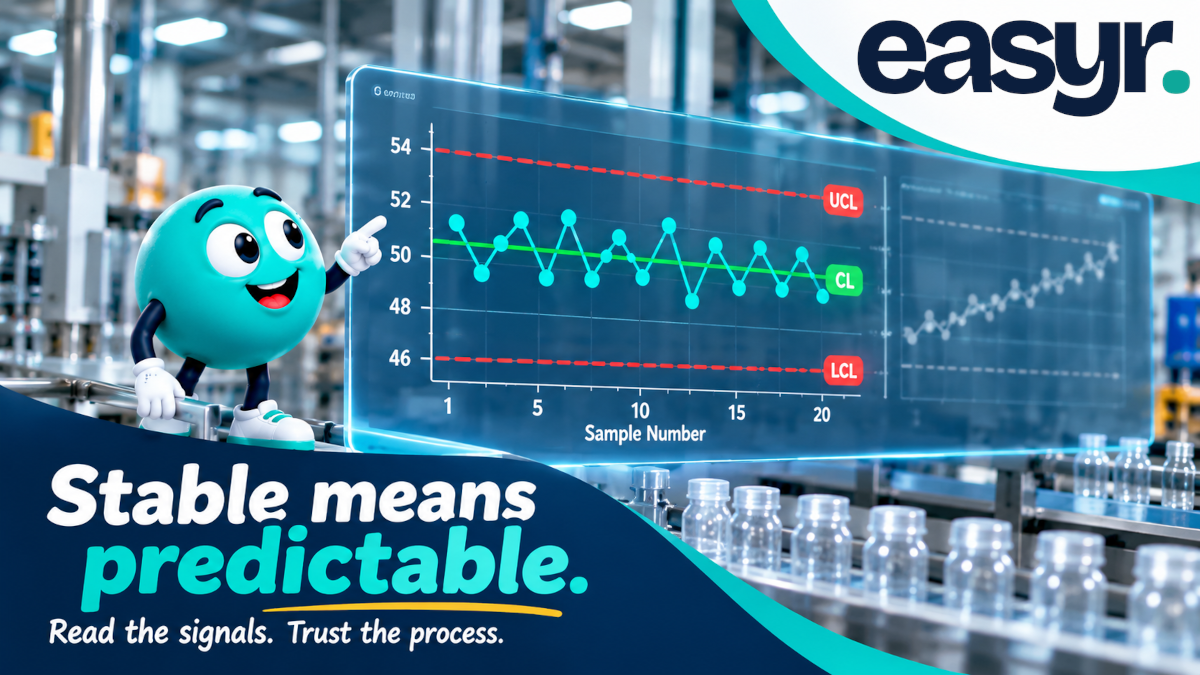
Your control chart is your window into process stability. Here's what you're looking for:
Points Inside the Limits: When all your measurements fall between the upper and lower control limits, that's good. But it's not enough by itself – you need to look at the pattern too.
Random Distribution: In a stable process, the points are scattered randomly around the centre line. About one-third are in the upper third of the chart, about one-third in the lower third, and about one-third in the middle. If they're all clustering in one area, something's off.
No Trends: A stable process doesn't trend steadily up or down. If you see the points climbing steadily (even if they're all within limits), that means something's changing – maybe tool wear, maybe temperature drift, maybe something else. But it's changing.
No Cycles or Patterns: Stable means random. If you see a sawtooth pattern, or waves, or anything that looks systematic – that's not randomness, that's a signal.
The Signals That Say "We Have a Problem"
Modern SPC systems look for these stability signals automatically, but it helps to understand what they mean:
Out of Control Point: A single point beyond the control limits. Something unusual happened on that measurement. Find out what.
Run of Eight: Eight consecutive points on the same side of the centre line. The process average has shifted. Something's changed.
Trend of Six: Six consecutive points steadily increasing or decreasing. Something's drifting – tool wear, temperature change, material difference, whatever. But it's changing gradually.
Two Out of Three: If you see two out of three consecutive points beyond the two-sigma limits (closer to the control limits), that's another signal. The process is getting more variable.
These aren't rules you have to memorise – your SPC system flags them for you. But understanding what they mean helps you respond properly.
How to Interpret Stability Over Time
Stability isn't a one-time check. You need to look at your process over days, weeks, months. Is it staying stable? Or is it gradually becoming unstable?
When you have a stable process running for an extended period, you can be confident in your process capability numbers. You can make reliable predictions. You can set realistic control limits.
If your process keeps generating stability signals, you haven't reached true stability yet. You've got special causes to eliminate – things that are making the process behave erratically.
Stable Doesn't Always Mean Good
Here's the part that surprises people: a process can be stable but still making out-of-spec parts. Your control limits are about statistical stability, not about meeting your specification.
So you might have a beautifully stable control chart and still be failing audits because your average is too high or your variation is too wide.
That's where process capability comes in. Once you're stable, you measure Cpk. That tells you if your stable process is actually capable of meeting your spec. If it's not, you need to improve the process itself – better equipment, tighter procedures, different materials, whatever it takes.
Why Your Operators Need to Know This
When your operators understand what stability means, they become your first line of defence. They're the ones running the process every day. They notice when something feels different, when a machine sounds off, when the material looks weird.
If they understand that control charts are looking for unusual patterns, and they understand what unusual looks like, they'll catch problems faster than any audit system. They become part of your quality team, not just people pushing buttons.
Getting to Stable (If You're Not There Yet)
If your process isn't stable yet, don't panic. It's fixable. The process is telling you something's not right – that's actually good information. Every stability signal you see is a clue.
Your job is to investigate. When you see a signal, dig into what was different at that time. What changed? Who was running it? What materials came in? What was the environmental condition? Every signal has a cause.
Eliminate special causes one by one, and your process will become stable. Then you can measure true capability and start real improvement.